
On 10 November, the DAM community gathered at the InterContinental Melbourne The Rialto for DAM Australia 2026. It was Henry Stewart’s third DAM event in our region and the first held in Melbourne, and I had the privilege of chairing the day.
The theme for Henry Stewart’s DAM events around the world this year was “The Intelligent Evolution of DAM”. That means the shift from static repositories to dynamic systems that understand content, automate workflows, enhance metadata and support smarter decision-making. Across the day, speakers from agencies, retail, cultural institutions, aviation and government showed what that evolution looks like in practice, and how uneven it can be.
Here is my perspective on the day.
Setting the Scene: DAM 1.0 to 4.0
I opened the day by acknowledging that many in the room have been lonely advocates for DAM, working hard to help their organisations see the value of the governance they maintain. Most have now reached DAM 2.0, with a connected DAM supporting the asset supply chain, although for many those integrations grew one point-to-point connection at a time.
Search still only works if you know how to look. AI has changed that expectation. People now ask for what they need and expect a contextual answer in seconds.
That is the shift behind the year's theme. What if an asset isn't just a file, but a web of connected pieces, contexts and relationships? That is what defines DAM 3.0, the Content Warehouse. An asset becomes a composite object, and its meaning comes as much from what it's connected to as from the file itself. That makes an integration strategy as critical to a DAM initiative as its taxonomy.
The payoff is a contextual answer to a question no folder structure can handle, such as: “Which campaigns featuring Brand Y delivered the highest engagement, and what visual characteristics did those high-performing assets share?” Beyond that sits the move from a content supply chain to a content demand chain: “right size, fit for this moment” content, rather than “one size fits many”.
The irony is that the AI era requires the deeply human work of deciding how to categorise and relate concepts. For those who have spent their careers advocating for well-structured information architecture, that should feel like vindication. I was also clear that not every organisation needs to reach DAM 4.0, or can. Some work best with a well-governed, integrated DAM 2.0.
The four stages come from Getting to DAM 4.0 by Jarrod Gingras of Real Story Group, whose framework gave the room a shared language for the day:
- DAM 1.0, Standalone Library: a central place to store and retrieve assets, disconnected from the wider technology stack.
- DAM 2.0, Connected Service: the DAM is part of the stack, with integrations up to creative operations and down to channels. Assets flow one way.
- DAM 3.0, Content Warehouse: media, narrative and data are managed as connected objects. Content is broken into reusable components, and data flows both ways.
- DAM 4.0, Intelligent Responder: the DAM responds to people and AI agents in context and in real time. The content supply chain becomes a content demand chain.
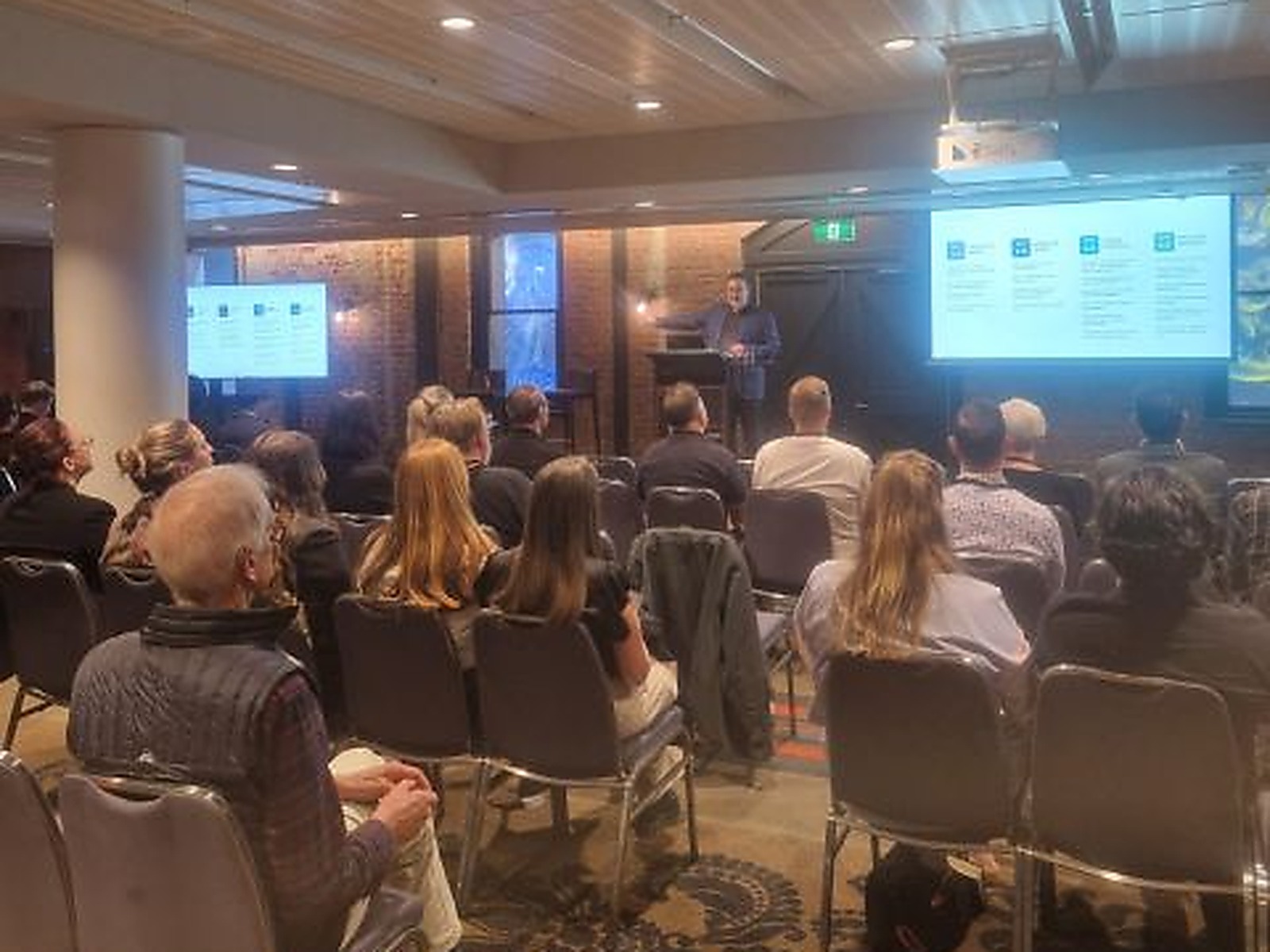
Thank you to Jarrod and the team at RSG for generously providing the slides I used to explain these concepts and set the scene for the sessions that followed.
The Evidence Layer: Agentic AI at WPP Production
Dan Robathan of WPP Production opened with a clear view of where DAM is heading. His team built agentic AI brief tools for L’Oréal that use its DAM 3.0 to assemble content and deliver right-sized media to each channel. The brief becomes the demand signal, and the Content Warehouse answers it. It was a strong example of DAM becoming a control tower, with content as the data record of truth.
Fireside Chat: Jetstar Airways Content Warehouse
My fireside chat with David Carroll of Jetstar Airways looked at their mature adoption of DAM 3.0. Jetstar uses atomic content to achieve its multilingual and personalisation goals through dynamic publishing across Asia Pacific. That foundation has set them up for a world of AI bots digesting and serving up content for their customers. Their Content Warehouse now underpins content delivery across every channel. It was an inspiring conversation about the payoff from investing early and committing to a transformational re-architecture of how they manage and deliver content and assets.
From Connected to Intelligent: The Integration Maturity Curve
Michael Coorey, my co-founder and our CTO at Creative Folks, framed his session around the law of unintended consequences. Five years ago, we were asking whether systems could connect. Today, we're asking how to stop them connecting in twelve different ways. His premise was blunt: most organisations have solved connectivity. Very few have solved coordination. Even fewer are ready for governed AI.
Point-to-point integration simply doesn't scale, and the stakes keep rising as legal, compliance, marketing, commerce and AI teams come to depend on the DAM. In Michael's words, we've spent twenty years treating DAM like a filing cabinet, and we're about to start treating it like a control tower.
His Integration Maturity Curve helps organisations assess where they sit, from manual processes through connected, orchestrated and intelligent integration. Most of the audience were at a level but not many were able to say they were orchestrated, and that jump is the hardest. It's where you stop solving individual integration problems and start building an integration strategy.
His message was simple. AI doesn't create truth. It consumes truth, so it needs access to trusted data. Context comes before AI. Start by solving the integration pain, not by adding AI to your DAM platform.
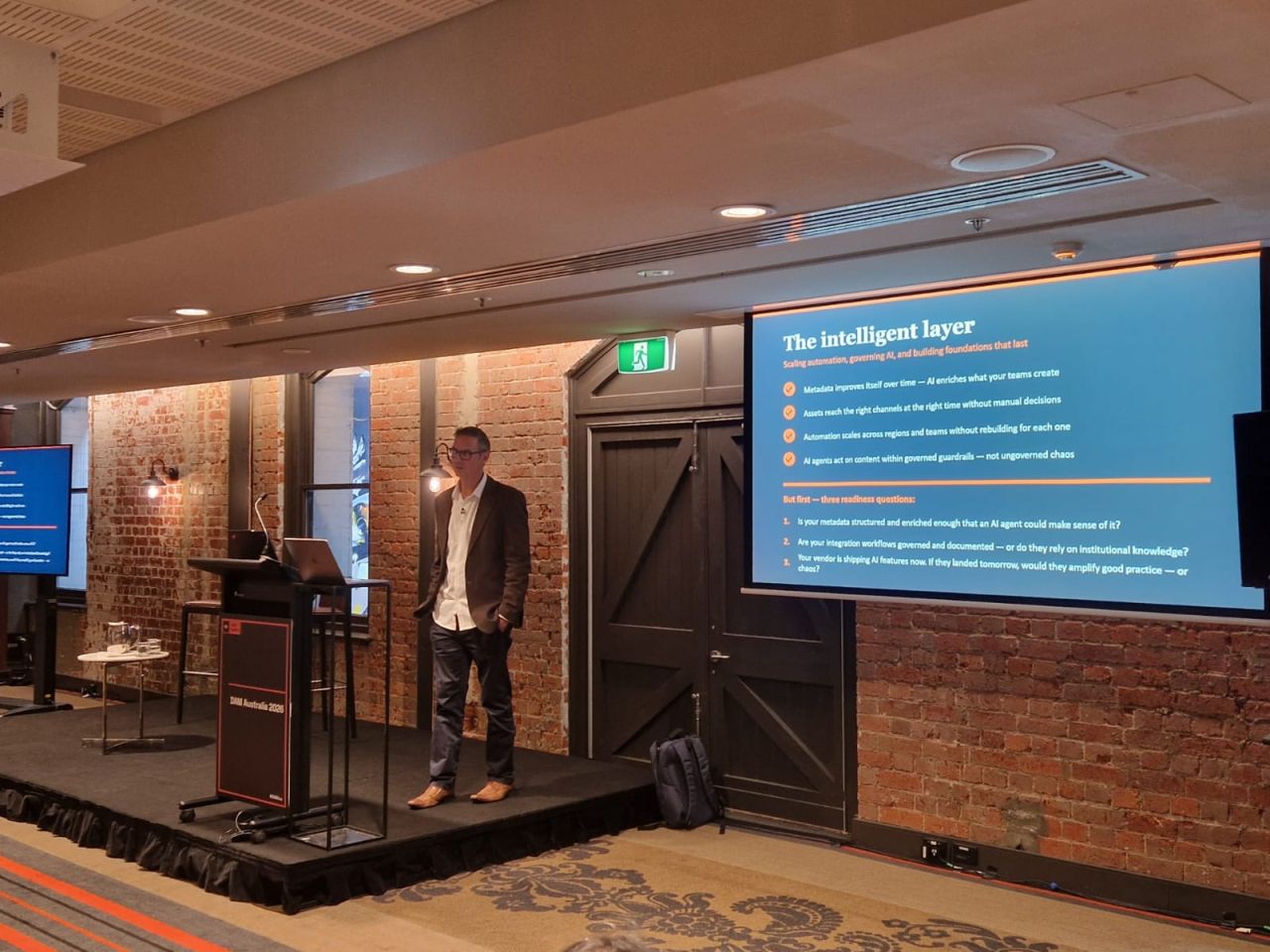
Sensitive Content at the Australian War Memorial
Sue Ducker of the Australian War Memorial shared how her team digitised more than 130 post-1975 private records collections, using an integrated collections management system and DAM to restrict sensitive material. In GLAM institutions, the relationship between those two systems is essential.
It really brought back into the spotlight the value DAM brings to preserving history as a rich visual vault. It also highlighted the role of the custodians who ensure accuracy is rigorously checked and access is appropriately limited, without limiting accessibility.
DAM 3.0: From Foundation to Enterprise Transformation
The DAM 3.0 panel, moderated by Nancy Colipe with Donna Cusack-Muller (The Australian Ballet), Thomas Walters (7-Eleven) and Owen Greenwell (Medium Rare Content Agency), explored what it takes to move from implementation to an enterprise capability. Each panellist brought a very different lens.
Tom’s approach challenged us all to think outside the box. He treats adoption as culture first. No one person can know everything, so he is building a village of champions and investing heavily in socialisation. He also makes the DAM fun by speaking 7-Eleven’s language: stockists put assets on the shelf, and shoppers consume them.
Donna has built a robust, well-established approval process at The Australian Ballet. Her team ran an extensive AI and facial recognition proof of concept, then chose not to proceed. The results didn’t justify the effort to maintain and train it.
Owen comes from a content production background, where DAM is institutional knowledge. Medium Rare recently took the risk of using the latest AI development tools to build its own in-house system, replacing a long-standing vendor platform. Ownership and long-term maintenance are still a work in progress, but being part of News Corp gives them the depth of resources and funding to back it.
Serving Up Content: Simplot and the Potato
Joe Madhess and Adibowo Rusli of Simplot looked at how to get assets from the DAM cupboards to the designers’ kitchen, and out to customers. It also delivered one of the biggest laughs of the day.
Someone in their business needed an image of a potato. Instead of searching the DAM, they asked AI to make one. For a business built on potatoes, with a library full of approved product shots, that says it all.
It’s funny because it’s familiar. Generative AI is now the easiest path to an image, and the easiest path wins. Governance now has to cover the shortcuts people take to circumnavigate access to systems or even including avoiding using the DAM. My view is that the answer is to make the DAM more accessible to business users. With new integration tools and MCP connections, a business user should be able to ask AI to find and retrieve assets from the DAM, rather than learn the interface, taxonomy trees and facets. Think of content as data you can ask AI to include.
Laying the Foundations: Architecture First
My own panel, with Simon Rutledge (CASA), Donna Slattery (Australian National Maritime Museum), Ryan Evans (APT) and Dan Mackerell (Coles), came at their DAMs from four very different starting points, yet all landed in the same place. Before governance, metadata or rights, understand where your content originates, how it flows through the organisation and how downstream systems will consume it. That means getting IT involved early and giving them a seat at the table.
The second major factor in a successful program was building DAM into the HR onboarding process, so it isn’t an afterthought or knowledge and process picked up along the way (good or bad), backed by continued training and awareness through socialisation and regular internal education sessions.
The Change Gap
Madeline Bowser of HaelioConnect gave a name to something every DAM manager in the room recognised. The change gap is the distance between what the technology can do and what your organisation is ready to support. Drawing on research and behavioural science, she showed why people and governance lag behind the technology, and her advice was direct: plan for and resource change management, and make readiness part of everyday DAM management.
A Question from the Room: What Happens to On-Premise?
One concern came up more than any other. Government and GLAM DAM managers with well-established on-premise platforms are being told by vendors that ongoing support will cost a premium, because development has moved to SaaS.
My answer had two parts. First, supporting both on-premise and SaaS means running two development teams. On-premise will get maintenance, not new features, so its runway is limited. Plan for that now.
Second, the market is about to shift. As DAM becomes the trusted content source for AI, expect the large platform players to want a share. New products built with AI coding tools will target the small and mid-market. The vendor landscape is likely to be shaken up in the short term.
The Day in Perspective
At the close, I shared the notes I’d collected through the day with the room, which sparked a lively debate about where the industry is heading:
- A well-governed DAM 2.0 can still solve core organisational problems. AI can enhance these ecosystems when it is clearly defined, given context and actively moderated.
- DAM is a program, not a project. This was repeated through the case studies and panels. That mindset has to last beyond go-live.
- Change management needs fresh thinking. Socialise the change and use surveys wisely, without adding to change fatigue.
- Linking DAM training to HR onboarding is a step most organisations miss. Nobody should get access to the DAM or connected systems without formal training in the standard operating procedures and best practices.
- DAM 3.0 is an attainable goal, but it needs a shared vision with leadership across departments, good resourcing and a complete rethink of content as reusable atomic objects, ideally with a data feedback loop to support contextual queries.
- The next DAM user is not a human. It’s an AI agent. More on that in a future post.
- Generative AI is now easier than finding the approved asset. Watch out for rogue images appearing and be on the front foot with governance. Make contextual search easier to remove the friction.
- Get IT involved early, make them your friend and give them the credit. Everyone likes being acknowledged for their part in success.
- AI makes the DAM a control tower. Content becomes the data record of truth. An orchestrated integration approach makes that data more accessible and the assets more valuable.
- The DAM manager role isn’t going away. It’s changing, and it matters more than ever.
- In GLAM, the relationship between DAM and the collections management system is essential. They are symbiotic twins that both perform a crucial role. In commercial scenarios PIM, ERP and DAM are also systems that must be connected for each part to be valuable in the content demand chain.
- ANZ is the least mature DAM region and one of the fastest growing. Enterprise vendors from the US and Europe are moving in. I anticipate a shake-up in the coming years.
- DAM 4.0 is a vision of the DAM as the Intelligent Responder. It’s evolving, not set in stone. The next 1-2 years will bring more certainty.
One more observation stayed with me. By a show of hands and the conversations during the day, I’d put the share of ANZ organisations at DAM 3.0 at 5% or less. The DAM Leaders Forum results shared by RSG put London at 42% and New York at 20%. That gap deserves its own post, and it’s coming next.
Thank You
Thank you to Henry Stewart for bringing the DAM community together in Melbourne, and asking me to chair this important event once again. I am very honoured. A big shout out to every speaker, panellist and delegate who shared so openly. That sharing is what makes these events different.
Where Creative Folks Can Help
Creative Folks has spent more than 25 years helping ANZ organisations get real value from DAM, optimising content operations with productivity automations and streamlining processes with data integrations. If any of the day’s themes resonated, we’d welcome the chance to compare notes.
Know where you sit before you plan what's next!